Tropic of Cancer
The Tropic of Cancer is in the northern hemisphere. It is about 22.5° north of the equator. The northern hemisphere tilts toward the sun in the summer (process begin the first day of spring). The Tropic of Cancer is the northernmost point (circle on the globe) where the sun can be seen directly overhead. This occurs there for one day, on the Summer solstice (between June 20 and 22, depending on the year), which is the first day of summer, which is the longest day.
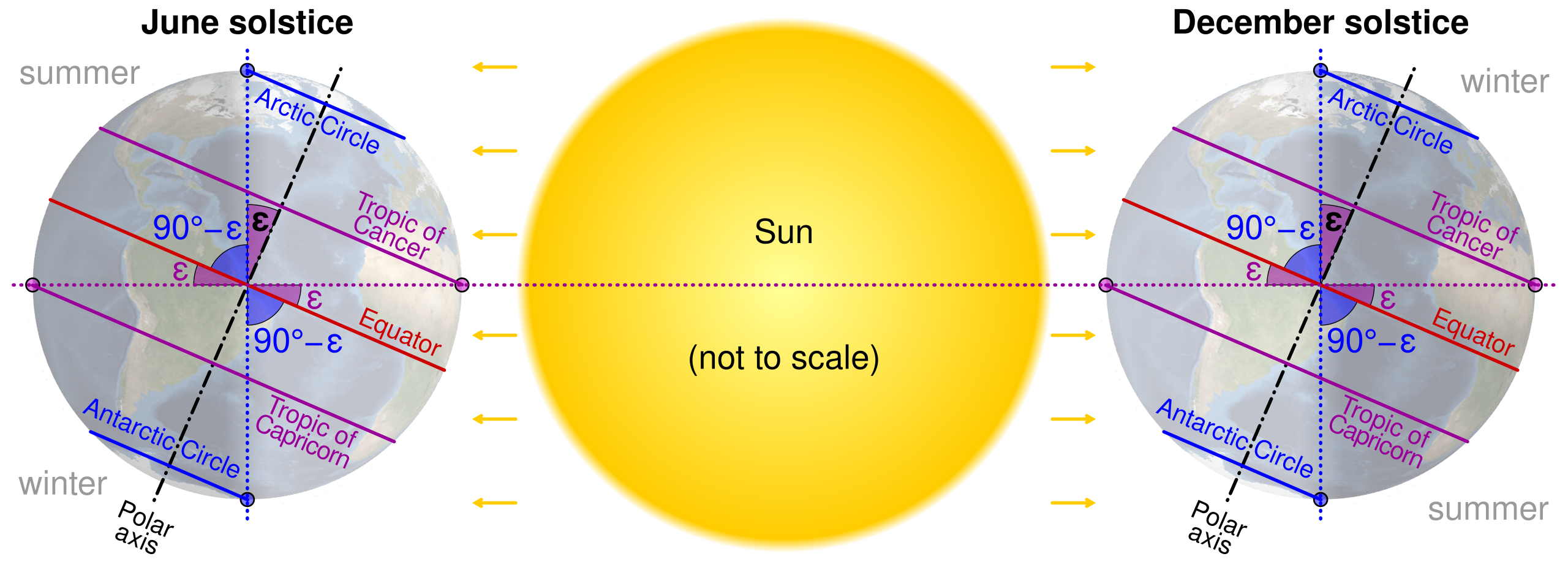
Solstice means sun stand still, from Latin sol (sun) and sistere (to stand still). The sun doesn’t really stand still but there is very little variation of the length of the day (and the angle of the sun in the sky) at this time of year, so it seems to “stand still.” This is the top of the sine curve. The change (the derivative) at the top of the sine curve (and bottom, OK, first day of winter, shortest day), is 0, and near 0 nearby.
By symmetry, this all applies in the reverse for the Tropic of Capricorn, in the southern hemisphere.
The Tropic of Cancer is below Florida, and therefore below 49 of the US states. It’s probably obvious, but the state of Hawaii is between the equator and the Tropic of Cancer. That’s why you can grow coffee there. 😊
Here is a great video on x.com.
Arctic Circle
While I’m here, let’s define the Arctic Circle (and symmetrically the Antactic Circle). The Arctic Circle is the southernmost latitude in the Northern Hemisphere where there is at least one full day each year when the Sun does not set (the midnight sun, around the June solstice) and one full day when it does not rise (polar night, around the December solstice). It is about 66.5° N. Inside the Arctic Circle they experience 24 hours of darkness (and 24 hours of light) at least once a year.
About 30% of Alaska is above (inside) the Arctic Circle. They experience multiple days of 24-hour sun and 24-hour darkness.